Quick Summary
Arielle Montgomery works at the intersection of Greenland, industry, finance, government, and Indigenous communities.
Her background is unusually broad. She began her career in investment banking, international energy, corporate strategy, and cross-border business, working in environments where capital, regulation, politics, and large institutions all collide.
Greenland became the place where those skills found a different purpose.
For nearly a decade, Arielle has spent substantial time across the country, particularly in remote communities such as Ittoqqortoormiit and Qaanaaq. She has worked closely with local operators, hunters, families, researchers, destination organizations, journalists, and decision-makers, building a perspective shaped as much by time on boats, in homes, and in small settlements as by boardrooms and policy documents.
That combination allows her to see Greenland differently.
She understands how investors think, how companies structure risk, how governments make decisions, and how international institutions operate. She also understands how quickly a strategy that looks sensible from London, Copenhagen, or New York can unravel once it encounters Greenlandic realities: weather, infrastructure, culture, trust, logistics, and community expectations.
Arielle’s work increasingly focuses on what comes next for Greenland.
She advises on resource governance, tourism, Indigenous Knowledge, economic development, strategic communications, community engagement, and the design of systems that allow more of Greenland’s economic value to remain in Greenland.
Her approach is practical. She is less interested in producing another report than in identifying the missing structure, incentive, institution, partnership, or person that will actually make an idea work.
She is also known for connecting worlds that rarely communicate well with one another: international investors and local communities, technical experts and policymakers, journalists and knowledge holders, commercial ambition and cultural reality.
Arielle has spent years building credibility by showing up, listening, and doing the work. She does not approach Greenland as an abstract market, a geopolitical talking point, or a place to extract stories.
She sees it as a country entering a period of profound change and one that should be in a much stronger position to shape that change for itself.
If your work in Greenland carries real economic, political, reputational, or community consequences, Arielle brings a perspective that is difficult to replicate.
Longer Personal Bio
I became aware of Greenland as a destination in 2012 when I saw the film by a fellow Stanford alum that changed my life: ‘Chasing Ice.’ I didn’t know anyone lived in Greenland nor had I ever given thought to a place that seemed so other worldly and desolate. The story they told in the film was very straightforward about climate change but the call to action made me feel compelled to do something. At the time it seemed preposterous because I worked for one of the largest oil companies in the world.
In addition to the stunningly beautiful but haunting ice, the Kalaallisuut / Greenland National Costume captivated me. There is a photo of me in an antique one below. The expressive and intricate beadwork and the masterful application of natural seal skin with embroidery and brilliant colors took my breath away. But when I learned that it can take about a year’s worth of work to make one, I really felt compelled to want to learn more about Greenlanders and their relationship with the land, the seal, and, of course, the ice.
I made the dream a reality in 2016 when I decided to execute on the promise I had made years earlier to do something. I turned 30 in Greenland but I never anticipated how much Greenland would come to dominate my life’s purpose. I now go as often as possible to learn about how climate change is impacting indigenous culture and the rapidly warming environment in one of the most remote civilizations on the planet.
It wasn’t intentional but understanding Greenland allowed me to reframe how I viewed problems and reshape solutions. This is why I have a mission to help others understand Greenland to see what it will unleash in them.
***
Greenland feels like another planet and the way of life there is unlike anything I’ve experienced. I’m at the mercy of the weather, the limited resources in a very remote part of the world, the ingenious inventions of the indigenous (we say Kalaallit for West Greenlanders or Tunumiit for East Greenlanders instead of “Inuit”) people to survive, the vast amounts of unspoiled nature, and the fascinating history.
Like snowflakes, icebergs are unique because the way they are born by breaking off a glacier. The big ones are so beautiful to witness that my photographs cannot capture the essence. There are expressive, interpretative, sculptural forms but others are absolutely abstract. Every single one, without exception, is an ephemeral design that inevitably disappears, never to be seen again.
What’s become clear over time is that my lived experience as a minority and a woman lends itself to understanding indigenous Greenlanders and a sensitivity to the nuances.
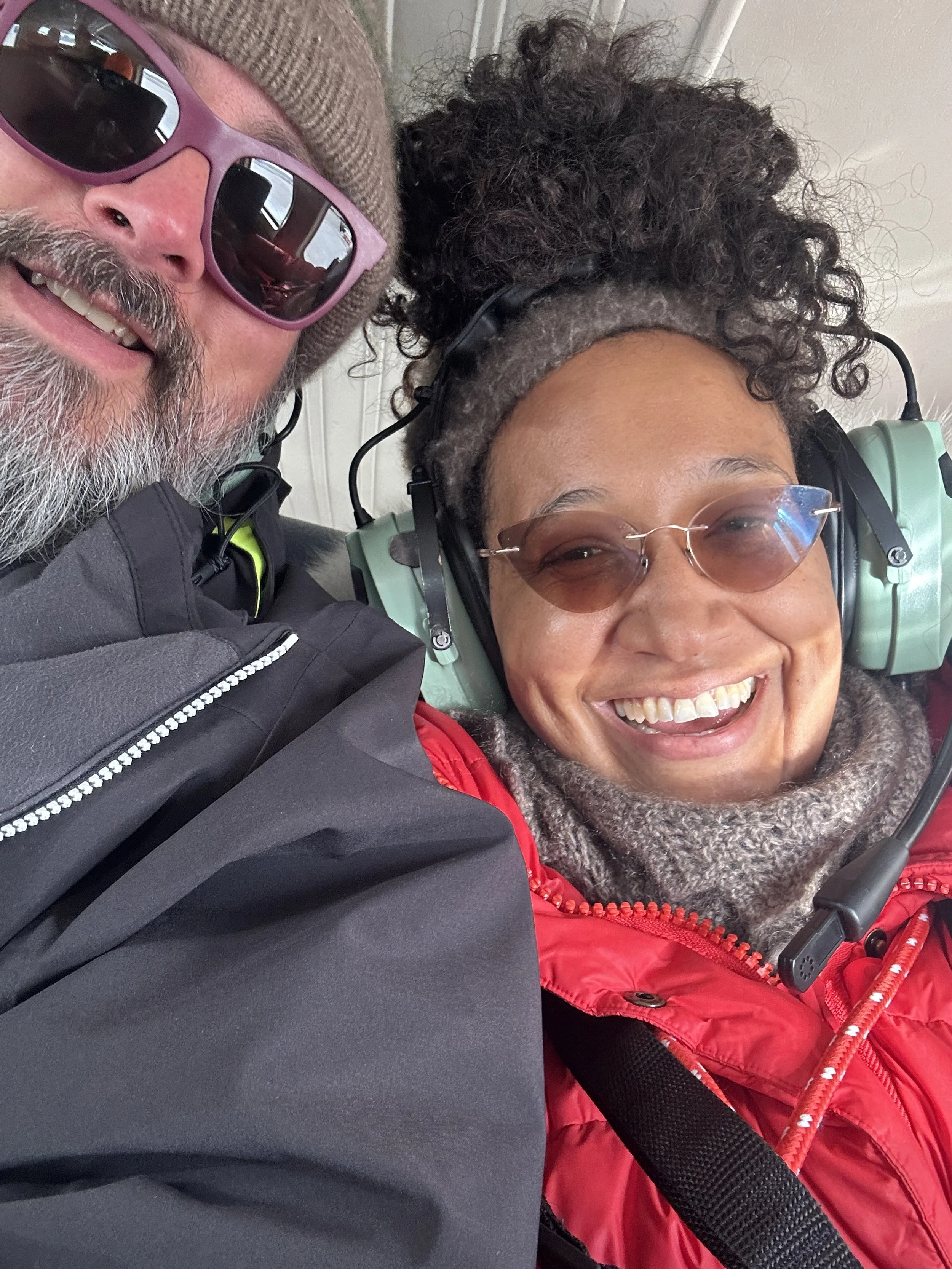
A note on images: I have personally taken all of the photos on this site unless noted otherwise. Please see the copyright info section to learn more.



Mission + Vision
Mission
To help Greenland build the institutions, strategies, and partnerships needed to turn outside interest into lasting Greenlandic benefit.
I work across industry, government, finance, tourism, and Indigenous communities to identify what is missing, design practical solutions, and help put them into action with Greenlandic knowledge, participation, and economic value at the center.
Vision
A Greenland that engages the world on its own terms.
One where Greenlanders have the expertise, institutions, leverage, and ownership to shape development themselves; where Indigenous Knowledge is valued as expertise; and where investment in Greenland strengthens communities rather than simply extracting from them.
We work with